












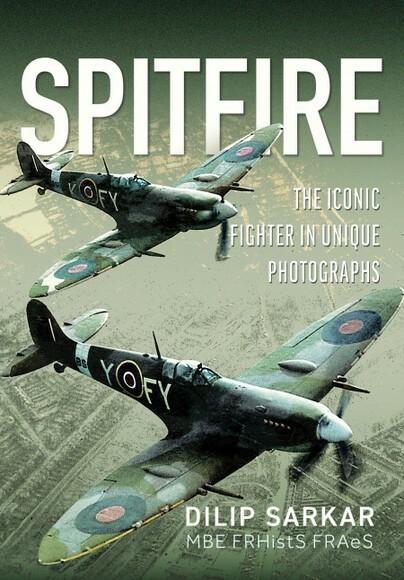
Few aircraft occupy the collective imagination of aviation historians, enthusiasts, and scale modelers quite like the Supermarine Spitfire. Its elegant lines, extraordinary combat record, and symbolic association with Britain’s survival in the Second World War have elevated it beyond the status of a mere weapon into a legend capable of eliciting a deep emotional response from anyone familiar with the Battle of Britain—surely one of humanity’s greatest survival stories. Countless books have been written about it, ranging from deeply technical references to pilot memoirs and lavish photographic retrospectives. Against this crowded backdrop, Spitfire: The Iconic Fighter in Unique Photographs by Dilip Sarkar manages to carve out a distinct and rewarding niche.
This book is not simply another catalog of airframes or a parade of perfectly staged official imagery. Instead, it offers an unusually intimate look at Spitfire operations through candid, often unofficial photographs in many cases taken under circumstances where photography was discouraged—or explicitly forbidden. The result is a book that feels personal and authentic, providing both historians and modelers with a perspective that is refreshingly different from the myriad books which preceded it.
An Authoritative Voice from the First Page
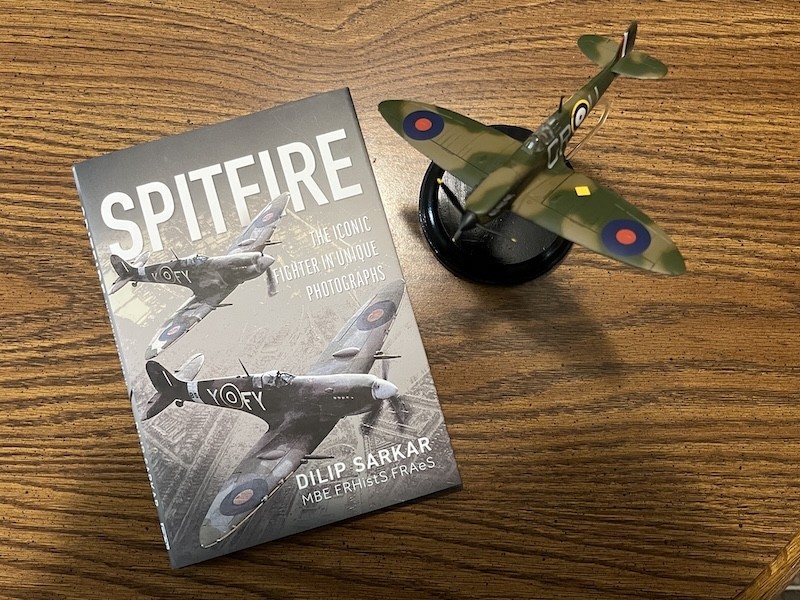
One of the book’s great strengths becomes apparent almost immediately: Sarkar’s authority on the subject. From the opening prologue, the reader senses they are in the hands of a deeply knowledgeable guide. Sarkar does not merely recount familiar milestones of the Spitfire’s development and service; he places the aircraft firmly within the broader narrative of the Second World War, explaining not just what happened, but why the Spitfire mattered when it did.
The prologue serves as a concise yet effective overview of the Spitfire’s operational history, its role within Fighter Command, and its symbolic importance during Britain’s darkest hours. This introductory section is particularly well judged. Rather than overwhelming the reader with excessive technical detail, Sarkar establishes context—strategic, historical, and human—before transitioning into the photographic heart of the book. This struck me in two specific ways: first, he acknowledges the Spitfire’s limitations—this is no hagiography—and second, he shows how human ingenuity continually improved on Mitchell’s original design to meet and exceed each new wartime challenge.

Photography as Historical Evidence
The title, The Iconic Fighter in Unique Photographs, is no exaggeration. The images presented here are genuinely distinctive, largely because of how—and by whom—they were taken. Many photographs originate from privately owned cameras, used discreetly despite wartime bans on photography at RAF installations. As a result, the images are candid, unposed, and sometimes technically imperfect.
As a result, some of these photographs might be described as “lower quality.” Focus is occasionally soft, and framing is informal. Yet these very limitations are what give the images their power. For the most part, they are not propaganda shots or official record images (though there are a few of those); they feel like viewing a scrapbook assembled by the men of Fighter Command. I particularly enjoyed one sequence where a pilot photographed his friend in front of a Spitfire, and then, in the very next photo, they switch places so the photographer can pose. All at once the war seems so human: just two young men excited to be flying the cream of their country’s air force into battle for their nation’s survival—it’s a delightful human moment.

Integration of Text and Image
What sets this book apart from many photographic collections is how effectively the text and images are integrated. Rather than presenting photographs as standalone curiosities with minimal captions, Sarkar uses them to build upon the narrative introduced in the prologue. Each image contributes to the unfolding story of the Spitfire in service, reinforcing the idea that this aircraft was not a static design, but a constantly evolving machine shaped by combat experience.
The accompanying text is informative without becoming intrusive. Sarkar clearly understands when to let a photograph speak for itself and when to provide additional context that enhances the reader’s understanding. This balance makes the book particularly engaging, as it encourages slow, thoughtful viewing rather than passive browsing.

A Human Perspective on an Icon
Another notable aspect of the book is its emphasis on the human dimension of Spitfire operations. Pilots, ground crew, and support personnel appear frequently, often in relaxed or informal moments. These images reinforce the idea that the Spitfire’s success was not solely a matter of engineering brilliance, but also of the people who operated and maintained it under immense pressure. And it fits within the book’s larger premise: personal photos taken by pilots and crews as proud and motivated young men caught up in a great moment in history, not as documentary photographers or propagandists.
This human presence adds emotional depth to the book and subtly shifts the reader’s perspective. The Spitfire emerges not just as an object of admiration, but as part of a broader wartime ecosystem.
Production Quality and Technical Details
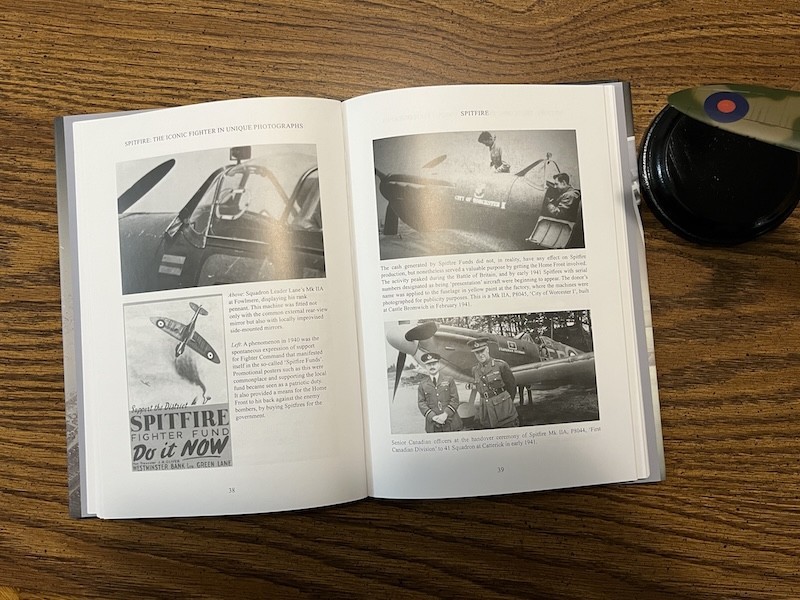
From a physical standpoint, Spitfire: The Iconic Fighter in Unique Photographs is a well-produced volume. Published by Pen & Sword Aviation, the book is presented in hardcover format, lending it a solid, durable feel appropriate for frequent reference. It runs approximately 128 pages (with the excellent prologue comprising an additional 28 pages), with photographs reproduced clearly and at a size that allows meaningful examination of details.
The paper quality is good, striking a balance between image clarity and readability without excessive glare. Captions are legible and thoughtfully placed, and the overall layout is clean and uncluttered. While this is not a glossy “coffee table” book in the traditional sense, it feels purpose-built for readers who intend to spend time studying its contents rather than merely flipping through it once.
Final Thoughts
This book succeeds because it understands its subject on multiple levels. Dilip Sarkar’s expertise is evident throughout, but it is his curatorial eye—his ability to select and contextualize photographs—that truly distinguishes this book. By focusing on candid, unofficial imagery and integrating it with a coherent narrative, he offers readers a fresh perspective on one of aviation history’s most familiar aircraft.
For scale modelers in particular, this book is highly recommended. It provides inspiration, reference, and historical grounding in equal measure. Whether used as a source of detail for a specific build or simply enjoyed as an evocative portrait of the Spitfire at war, it is a volume that rewards careful, repeated viewing.
In a field crowded with Spitfire titles, this one earns its place not by repeating what we already know, but by showing us what we rarely see.