












Introduction
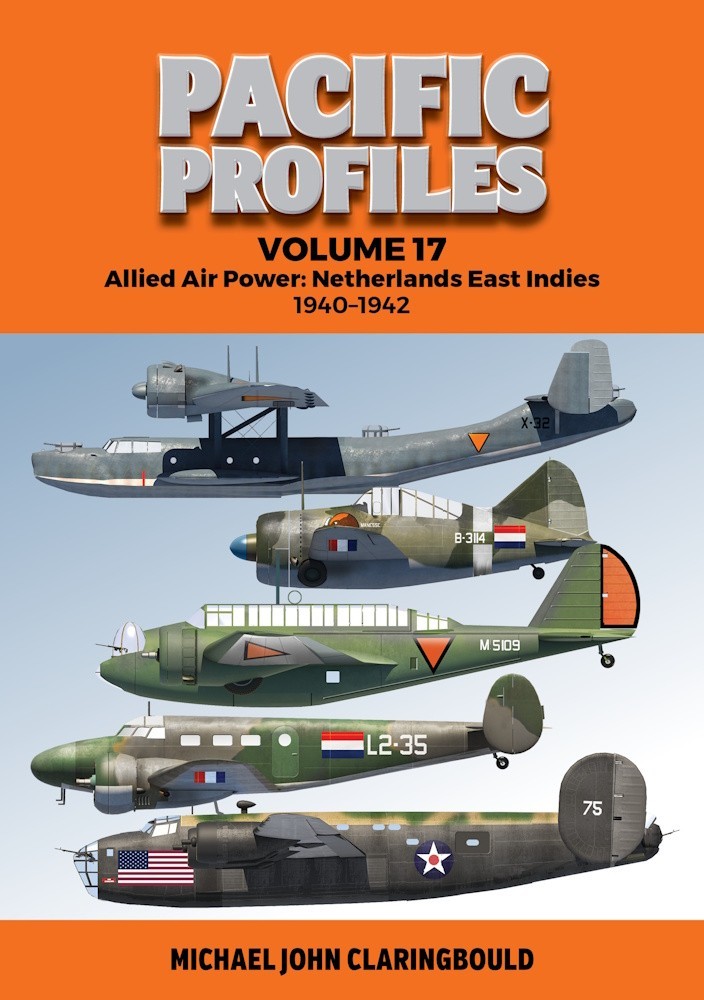
Pacific Profiles Volume 17 Allied Air Power: Netherlands East Indies 1940-1942 is a recent full color, fully illustrated release from Avonmore Books, authored by Pacific air war authority Michael John Claringbould.
108 pages
250 x 176mm
ISBN 9780975642375
RRP $36.95
Background
Japan’s victorious rampage through Asia and the Pacific in early 1942 brought them into fights with several countries and empires. Eclipsed by the American and British disasters in Malaya and the Philippines was the major campaign for the Netherlands East Indies. While Singapore folded like a cheap suit and the Philippines collapsed, four militaries combined into ABDACOM (American-British-Dutch-Australian Command) in an attempt to hold the Japanese onslaught. ABDACOM’s ground and naval units were supported by six air forces (counting naval air forces separately) which flew dozens of fascinating disparate types, perhaps closely described by the traditional wedding rhyme "something old, something new, something borrowed, something blue". Those warplanes - and impressed civilian aircraft - included trainers, transports, rare interceptors, state of the art designs, biplane relics with uncowled engines, “the best second-best” types, long in the tooth former world-beaters, obsolescent models soon to write glorious chapters in the annals of air warfare, and those destine to be reviled.
Modelers - this book is primarily a historical and visual presentation, full of facts, analysis, photographs and original artwork by the author. He addresses the colors, markings, serial numbers, camouflage and variations of the types and versions of the various air forces. Combat aircraft over the Netherlands East Indies (NEI) included those purposely assigned there, or impromptu reassignment from other theaters. Thus they flew with a variety of official and ad hoc camouflage colors and patterns.
For this herculean effort the author gleaned information from surviving assignment data, factory orders, wreck reports, squadron records, maintenance logs, diaries, marking specifications and air base records to clarify and correct past inaccuracies concerning ABDACOM aircraft. The fight for the NEI was short and chaotic, with records and archives - and aircraft - scattered, lost or captured all over the Southwest Pacific and Indonesia. It was a technological bonanza for Japan which captured - often airworthy for flight testing - almost every aircraft they would face over the next year and a half. In their own words Avonmore tells us;
This Volume 17 covers Allied types that fought in the brief but intense Netherlands East Indies (NEI) campaign from December 1941 to March 1942. Because of some additional background on Dutch types, the full scope of this volume is from 1940 to 1942.
The Netherlands East Indies saw a diverse and eclectic gathering of Allied aircraft. Many of them were Dutch, serving with the Royal Netherlands East Indies Army Air Force (ML-KNIL) and Netherlands Naval Aviation Service (MLD). These included Glenn Martin Model 139 bombers and Hawk 75, CW-21 and Brewster Buffalo fighters, together with Fokker and Dornier seaplanes.
Several squadrons of RAF and RAAF fighters and bombers withdrew from Singapore to continue fighting from Sumatra and then Java. These were augmented by direct reinforcements flown into those locations. These aircraft mainly comprised Hudsons, Blenheims and Hurricanes but there were also more obscure types such as Albacores and Vildebeest.
In addition, American B-17C/D heavy bombers and PBY flying boats retreated from the Philippines to the NEI. These were reinforced by modern B-17E, LB-30 and PBY aircraft from the US ferried via lengthy African and Pacific air routes. Lastly, small numbers of A-24 dive-bombers and P-40E fighters flown from Australia also joined the fight on Java.
Modelers and historians, come along and see the inspiration and source material this book offers.
Content
Allied Air Power: Netherlands East Indies 1940-1942 is divided by Royal Netherlands East Indies Army Air Force (ML-KNIL) and Netherlands Naval Aviation Service (MLD) aircraft, and those of Allied countries.
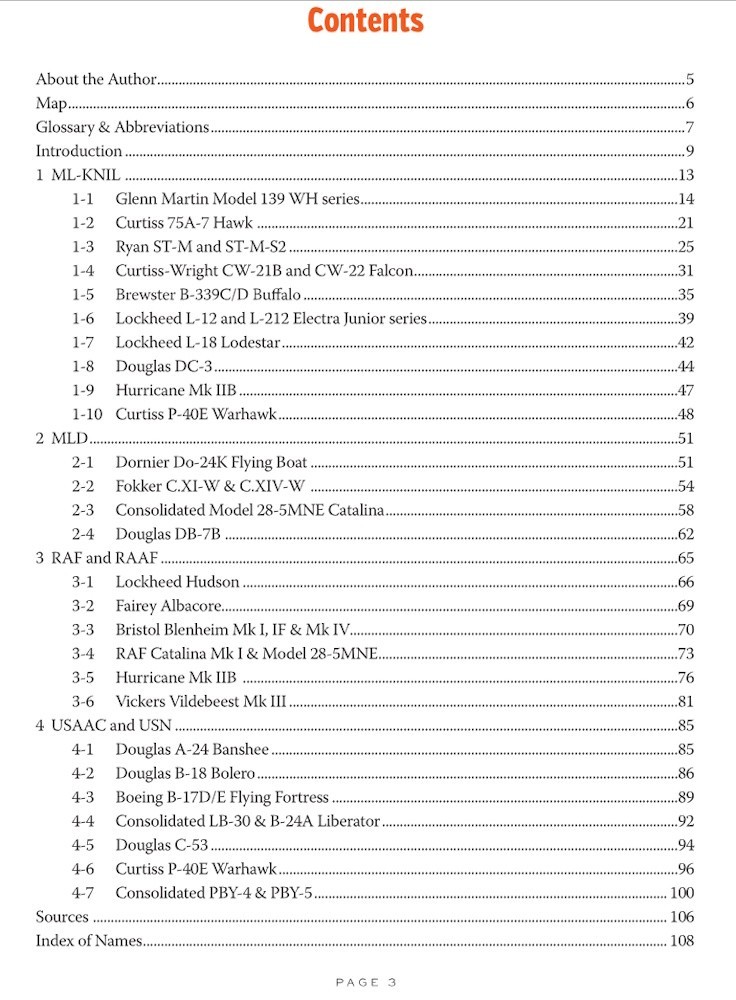
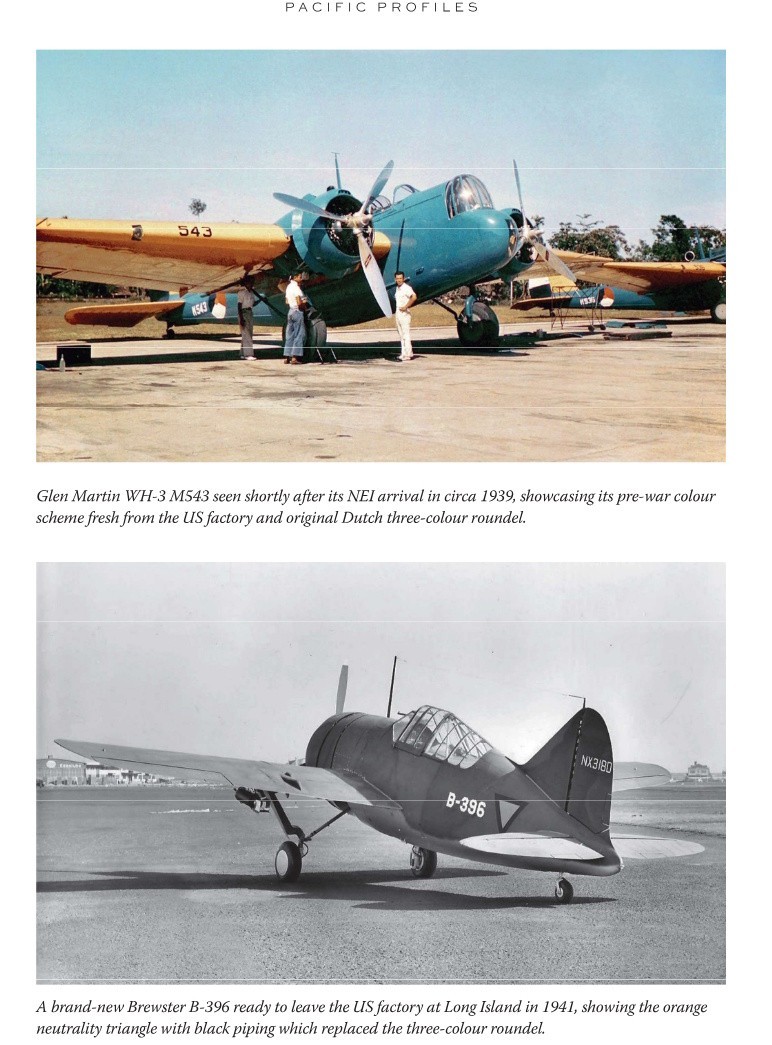
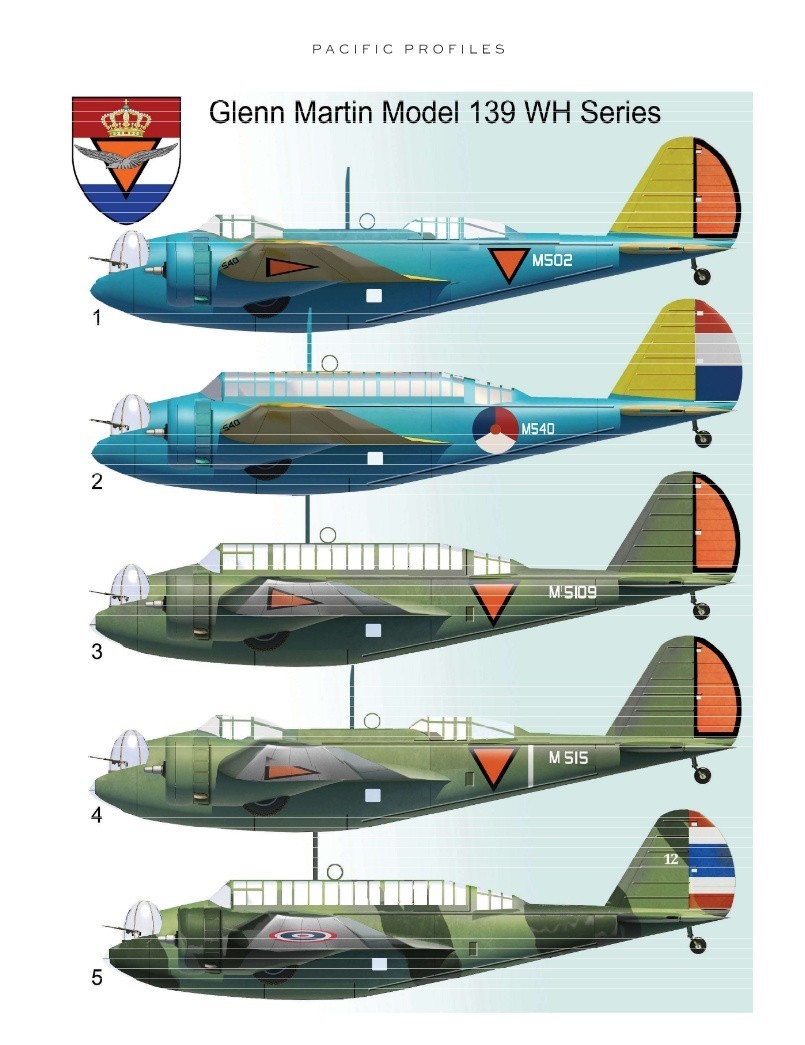
Aircraft histories began with its historical, operational and technical background. NEI’s roundel national insignia was the Dutch tri-color before Germany started their Pan-European war, after which it transitioned to an orange neutrality insignia until Japan expanded their Pan-Asian war. Then it switched to the Dutch flag. Mr. Claringbould explains the difference between the Dutch government and the nature of the NEI, and the need to support an air force on the other side of the world from the home country. He explains the riot of non-standard and changing markings. The depth of research despite the fragmented and incomplete records is demonstrated by the author’s ability to name serial numbers in connection to schemes, and the use of non-standard schemes.
Pacific Profile books focus on specific aircraft models and types, i.e., Japanese Army fighters, Boeing B-17s, Bell P-39 Airacobras, Japanese seaplanes, etc. As such the author could focus on the subjects individual squadrons and groups. In this monograph the sheer number of Allied aircraft that defended the NEI, their chaotic squadron assignments - the British formed a provisional squadron of the same number as an established squadron - and lack of records prevents the same treatment. Not to mention keeping within the Pacific Profiles page count format. Instead, it identifies the initial squadrons the aircraft equipped, unit assignments between different parent units as attrition or maintenance dictated, and the impact upon the challenge of properly identifying which units a particular aircraft was a part of in a particular time. That is one scholarly aspect of this work.
That is what to expect for the 27 chapters of specific aircraft classes and types. Each squadron receives, to the extend records are available, brief histories including dates and locations of origins, commanders, significant dates, deployments, combats, disposition after capture, and interesting anecdotes. As mentioned above, this is primarily a visual presentation of the subjects. Thus, each aircraft type is supported with numerous color illustrations by the author, most of which are of documented airframes, most of which are validated through photographs. Each image is supported with a narrative of varying detail; for instance, Glenn Martin Model 139 (as ML-KNIL’s export Martin B-10s were known) includes its camouflage, date of capture, and the Japanese transfer of it to Thailand. P-40E 40-663's history includes the pilot, his noseart, mention of combat, and fates. Another caption recounts a certain transport returned to the USA for Dutch flight training duty. Still other profiles document and display Navy PBYs in unique theater camouflage. Other interesting stories include Allied aircraft abandoned due to damage yet made airworthy and used by Dutch crews. Further stories document what became of Dutch aircraft after NEI capitulation. Other trivia includes the fate of aircraft that were at Broome and Darwin during Japanese air raids.
The text is very interesting and imparts the desperation of the NEI defense, and the fascinating aircraft involved.
Photographs, Artwork and Graphics
Modelers will find a splendid gallery of of black-and-white and even color photos to support the text. Many are inspirational for dioramas in addition to helping us model the best particular aeroplane we can manage. They provide a great deal of value beyond presenting the subject of this book. They span the gamut of professionally exposed and developed images to amateur pictures. Some show damaged or abandoned aircraft. The author chose excellent images that visually confirm insignias and odd airframe finishes. Of particular interest are:
- Color shot of a Model 139 in NEI sporting the United States Army Air Corps prewar blue fuselage with yellow wings, with ML-KNIL insignia.
- Color photo of MLD PBY at San Diego.
- Ryan ST-M-S2 floatplane on the step.
- Do-24K in flight with a Fokker floatplane.
- Fokker C.XI-W with unique zigzag camouflage.
- Hawker Hurricane being field serviced at Singapore.
- LB-30 refueling from a civilian gas truck.
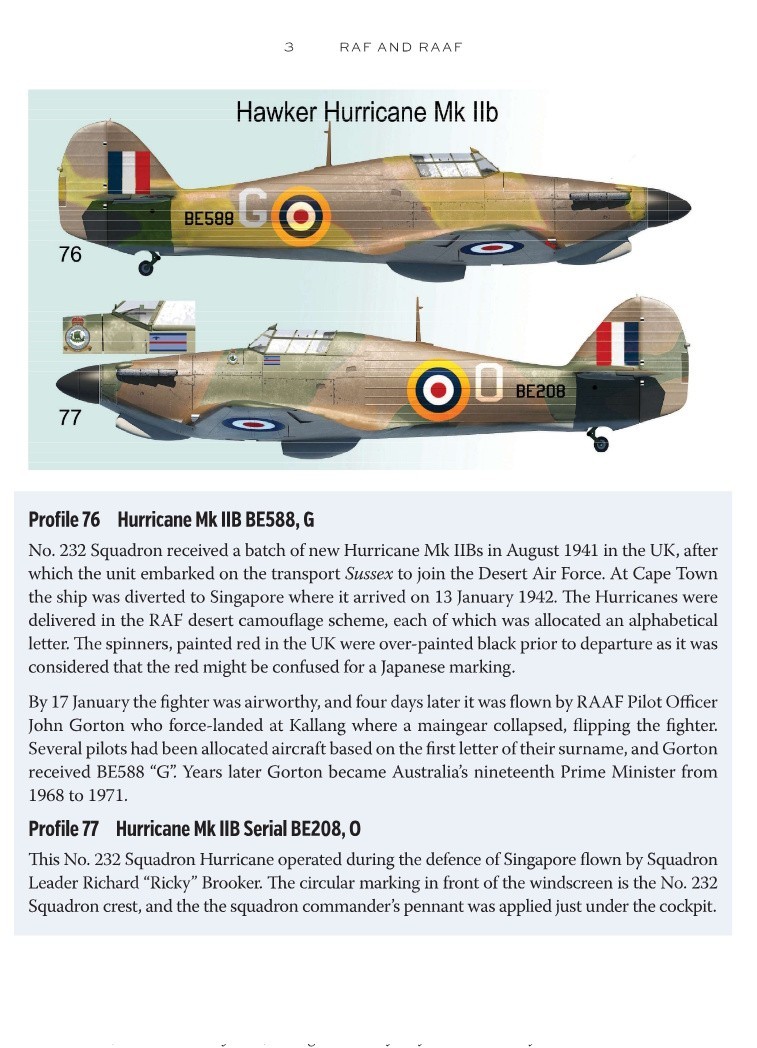
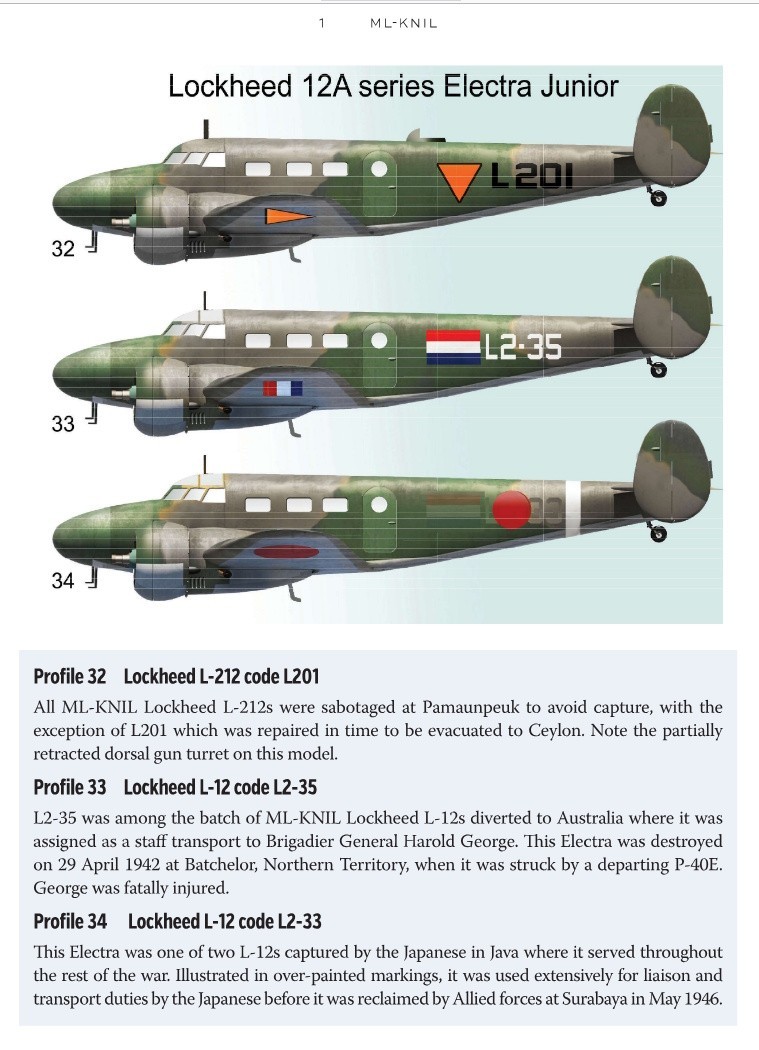
Perhaps the most impressive part of the book is the original color artwork by the author of select aircraft. As previously mentioned, each profile is supported by photos and/or documentation. As in the artist’s other books, weathering and wear is illustrated. His experience as a pilot helps him to authentically render atmospherics for in-flight illustrations.
Profiles are authenticated with a wartime photograph of the aircraft. Most of the profiles include a line or two, or a small paragraph, of narrative of the history of the aircraft.
Profiles
Boeing B-17D/E Flying Fortress: five profiles.
Brewster B-339C/D Buffalo: five profiles and squadron 2-VIG-V's badge.
Bristol Blenheim Mk I, IF & Mk IV: five profiles.
Consolidated LB-30 & B-24A Liberator: two profiles.
Curtiss 75A-7 Hawk: four profiles.
Curtiss P-40E: five profiles for USAAC, and one Dutch and one Japanese.
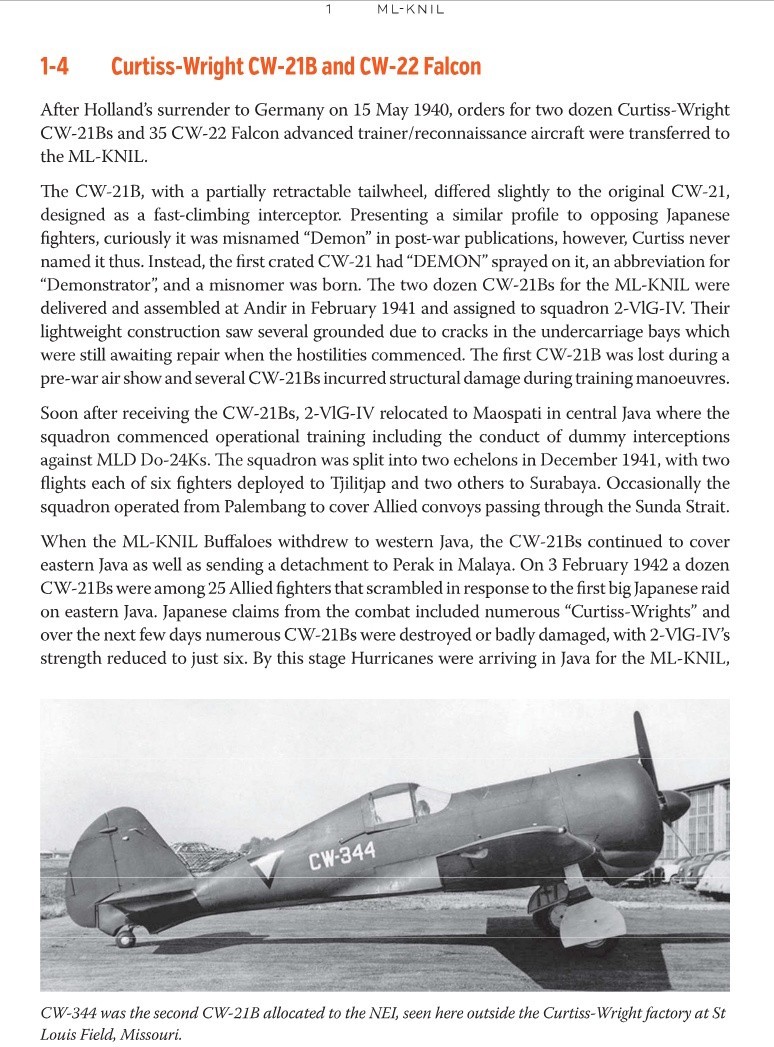
Curtiss-Wright CW-21B and CW-22 Falcon: six profiles including captured CWs.
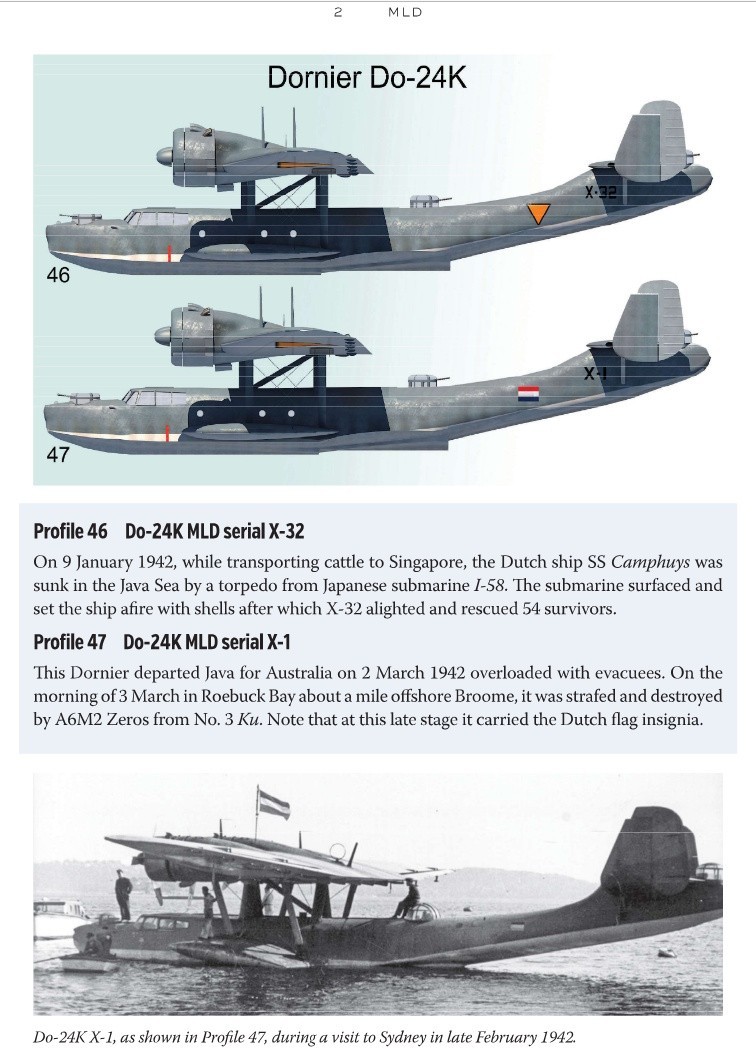
Dornier Do-24K: two profiles.
Douglas A-24 Banshee: two profiles.
Douglas B-18 Bolero: two profiles.
Douglas C-53: two profiles.
Douglas DB-7B: one Dutch and two Japanese profiles.
Douglas DC-3: five profiles.
Fairey Albacore: two No.36 Squadron examples.
Fokker C.XI-W & C.XIV-W: six profiles.
Glenn Martin Model 139 WH Series: eight aircraft in prewar or wartime markings and finishes.
Hurricane Mk IIB: five British and two Dutch profiles.
Lockheed Hudson: three RAF and a Japanese profile.
Lockheed L-12 and L-212 Electra Junior: three profiles including a Japanese trophy.
Lockheed L-18 Lodestar: two profiles.
PBY: profiles of four Dutch, three RAF, and six USN PBYs.
Ryan ST-M and ST-M-S2: eight profiles with various colors and insignia.
Vickers Vildebeest Mk III: four profiles for No. 36 and 100 Squadrons.
Color illustrations
Do-24 patrolling the Java Sea.
Fokker C.XI over Java.
PBY-4 in unique camouflage on patrol.
Ryan ST-M trainer over Java (on back cover).
Map
Netherlands East Indies, Allied Airfields & Naval Bases, January 1942: The author provides a map of the area from southern Indochina and Sabang on Sumatra, to NW Australia up to Sorong, New Guinea, then east of the southern Philippines.
USAAC Delivery Routes, January/February 1942: Amberley Field to Surabaya.
Conclusion
For decades I have looked forward to a book that presents the ML-KNIL, MLD, and Allied aircraft of the defense of the Netherlands East Indies. Thanks to Mr. Claringbould and Avonmore, we have another essential book for modelers, students and historians of that air war. Modelers of export Martin B-10s, Curtiss-Wright's specialist CW-21 and 22, RAF and Fokker aircraft and others, now have a modern wonderful resource to inspire model subjects of 23 aircraft types. This book represents them through 107 colorful profiles. The accuracy of the color profile interpretations are authenticated by contemporary photographs.
While I would acquire this book for the gallery of images alone, the research presented by the text is illuminating and fascinating, and I enthusiastically recommend it.
Please remember to mention to Avonmore Books and retailers that you saw this product here - on Aeroscale.