












Introduction
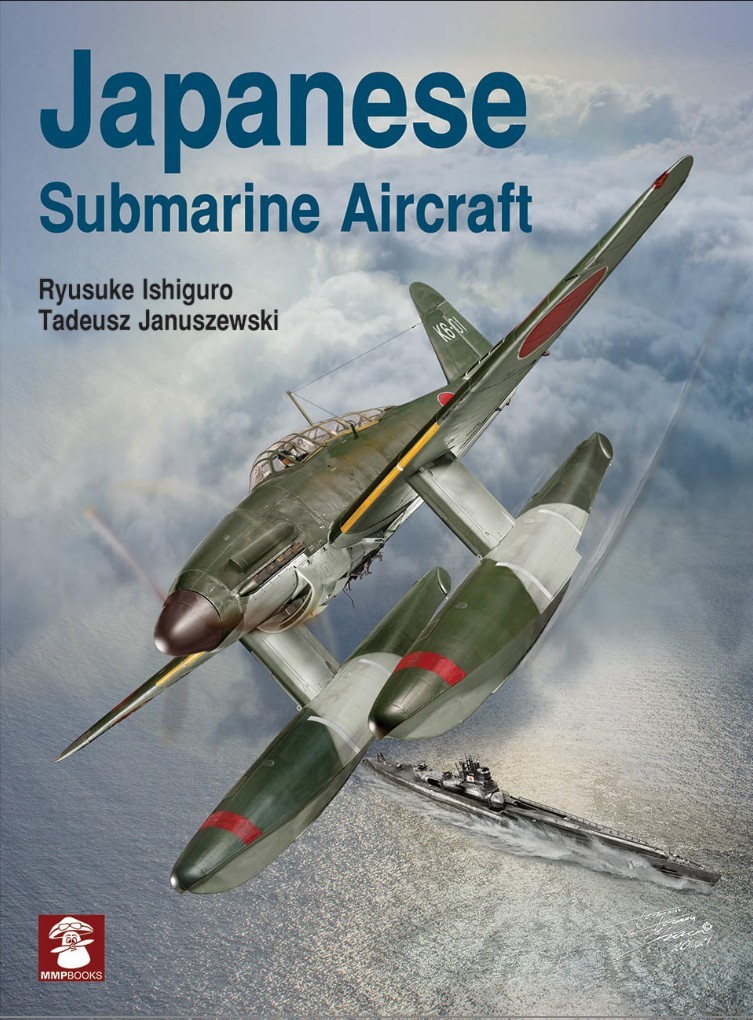
Japanese Submarine Aircraft, 2nd Edition is a recent book from MMPBooks. Authored by Ryusuke Ishiguro and Tadeusz Januszewski, and illustrated by Dariusz Karnas, this 176-page A4 sized hardback features color illustrations and catalogued with IBSN 9788366549562. It expands an abbreviated similar title from the early 2000s.
Written for modelers as well as historians and researchers, this book contains a great deal of detailed technical data and service histories, supported by technical drawings and color illustrations.
MMP writes of this title:
Authors Ryusuke Ishiguro and Tadeusz Januszewski describe step by step the development of the concept, the aircraft designs, and the operational use of submarines equipped with hangars and catapults for seaplanes.
The book includes:
complete technical data and histories of aircraft such as the Yokosho E6Y1, Watanabe E9W1, Kugisho E14Y1 Glen, and the Aichi M6A Seiran bomber,
accounts of the most important combat missions – including over Pearl Harbor, Sydney, and Melbourne,
technical plans, colour aircraft profiles, and unique archival photographs,
the history of the unfulfilled offensive against the Panama Canal and the planned use of biological weapons.
Models of Japanese aircraft carrier submarines are some of my favorite ship subjects, and recently the decision to concentrate on Japanese floatplanes and seaplanes makes this subject more interesting. Thanks to inspiration and detail in this book, models of these subjects are certain to populate my model shelf.
Contents
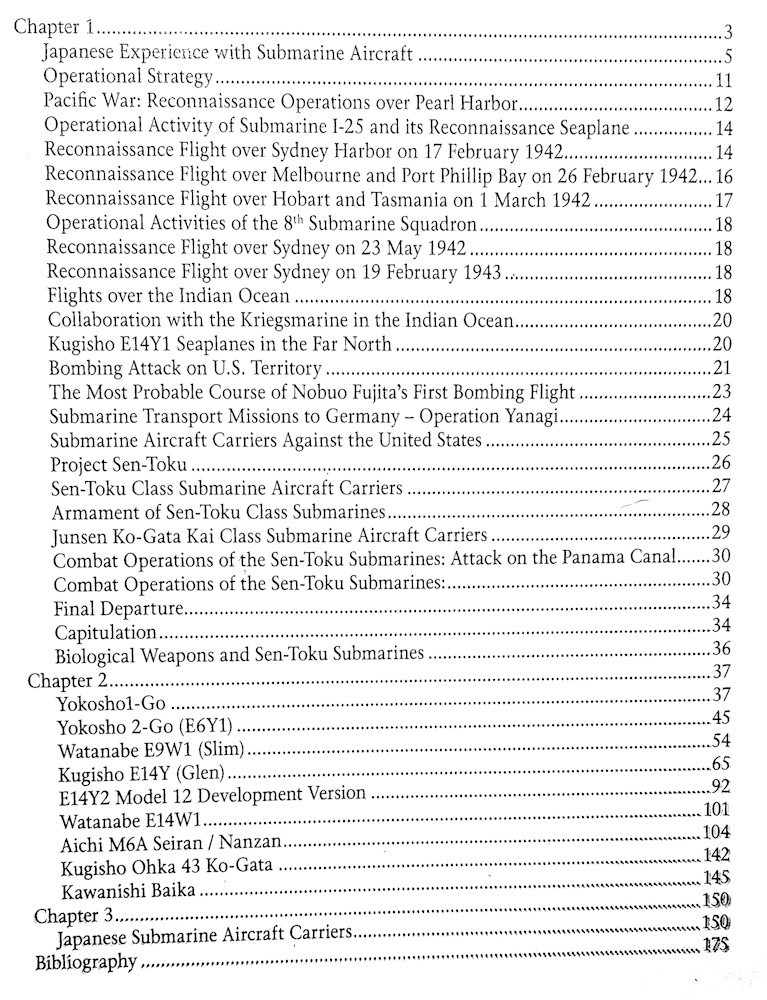
Japanese Submarine Aircraft is presented through three chapters. First, they detail the development and history of sub-launched aircraft, missions and activities of subs and aircraft, weapons,and biological weapons developed for the weapon systems. The second chapter examines nine aircraft types through 113 pages. Chapter 3 recounts Japanese Submarine Aircraft Carriers.
Table of Contents
Background, Development, Operations and Missions
Messers. Ishiguro and Januszewski afford the reader the opportunity to geek out and learn more Japanese technical and military terms, e.g., Dai 1 Senui Sentai (1st Submarine Division), Dai 8 Sensui Tai (8th Flotilla). Kanji symbols, i.e., 伊号第1潜水艦, shows the depth and accuracy of the research. They also explain the "I" classification prefix of many submarines. They also reveal that the Japanese were working on submarine-launched rocket and pulse jet-powered Kamikazes.
Chapter 1 starts with the history of the first submarine-based aircraft attack (1915!) and successive developments. This flows into other countries' experiments with the concept, and Japan's adaption of the tactic, and European prototypes Japan adopted. Herein we learn of Japanese terminology, i.e., It-to Sensuikan were ocean-going and sea-based subs with displacements over 1,000 tons. Successes and failures are detailed along with lessons learned from both outcomes, and developments to improve either. Eventually, Japan designed and built the large and advanced Sen-Toku Class of submarine aircraft carriers, known as the I-400s. Their advanced technology led to the United States enacting Operation Roads End - sinking the I-400s rather than sharing the subs with the Soviet Union. The operation was classified until recently.
Operational Strategy explains how Japan would use these weapons. The subs also sailed to and from Germany. Japanese submarine aircraft were more active than realized, flying multiple mission to Pearl Harbor, several Australian targets, the Indian Ocean, the Aleutians, and firebombing attacks against the continental United States. The authors detail even grander operations against targets on the American continent.
The Aircraft
Chapter 2 is why this book review appears on Aeroscale - it is full of aircraft. Nine makes, models and series are examined and explained.
- Yokosho 1-Go
- Yokosho 2-Go (E6Y1)
- Watanabe E9W1 (Slim)
- Kugisho E14Y (Glen)
- E14Y2 Model 12 Development Version
- Watanabe E14W1
- Aichi M6A Seiran/Nanzan
- Kugisho Ohka 43 Ko-Gata
- Kawanishi Baika
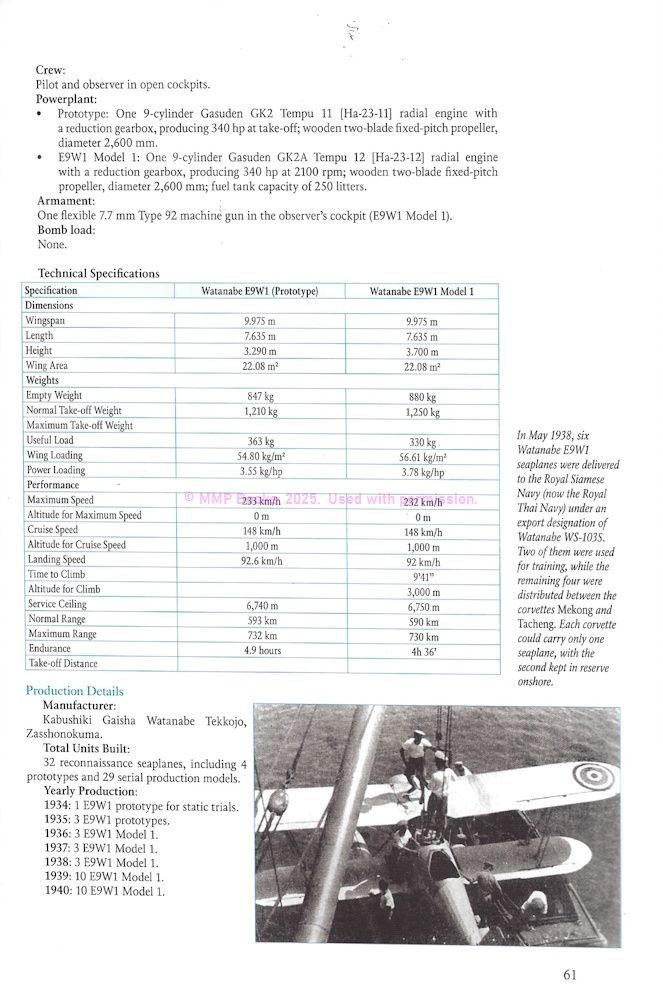
Early designs were developed from Great War European designs. Each aircraft receives a detailed discussion of the technical specifications, designs and construction of the aircraft, and their influence on changes to submarines. As appropriate or documented, we learn of flight testing, basing, and operations. Furthermore, paint schemes and technical specifications are presented for each aircraft, including a technical data table, and production information, and chronologies of the aircraft manufacturer. Finally, line art and color illustrations in modeling scales 1/72 and/or 1/48 provide modelers with good visual references. Supporting data sometimes includes finishes and markings for particular pilots on specific operations.
An example of the comprehensiveness of the authors is demonstrated in the E14Y1 subchapter, for which the authors include a 26-step procedure for launching or landing the aircraft from its sub. They also include numerous high-quality technical photos of the Glen:
- Internal structures
- Exterior details
- Construction process
- Cockpit apparatus
- Actuators for flight controls
- Airframe assembly attachment components
- Machine gun mounts.
The Submarines
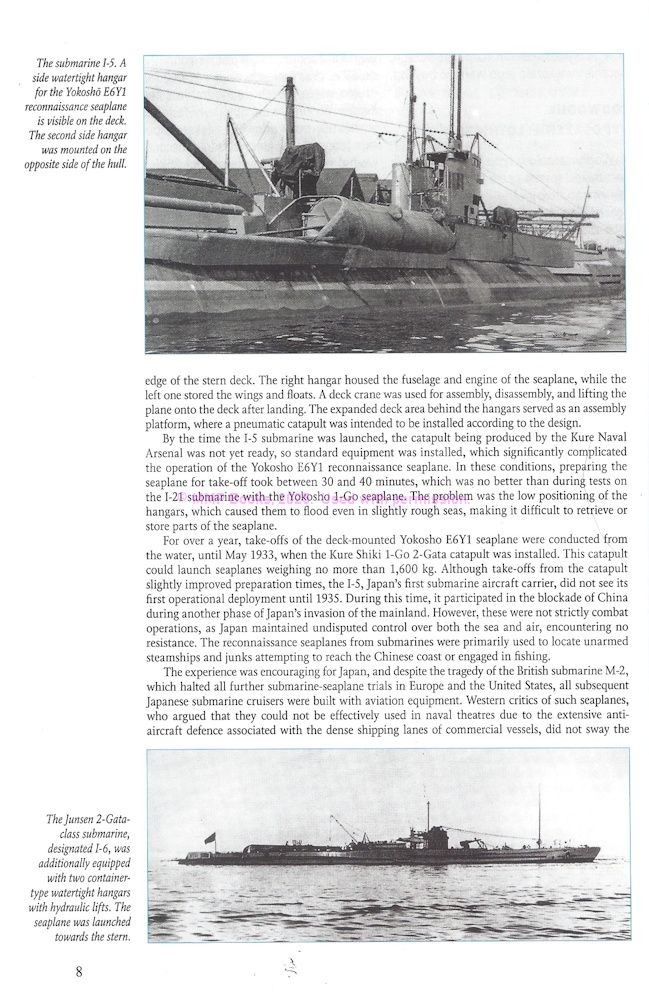
This final chapter details the aircrafts' conveyances. Messers. Ishiguro and Januszewski begin with recounting the historical events leading to the submarine aircraft carriers. We learn of the Naval Expansion Supplement programmes (Maru Keikaku), designs, technical specifications and tables, sea trials and important dates when known, design and equipment changes, and operational records of the vessels, e.g., Submarine I-5 of the Junsen 1-Gata kai Class (I-Go Dai Go Sensuikan), chronologies, and the organization of the submarine 6th Fleet (Dai-roku Kantai).
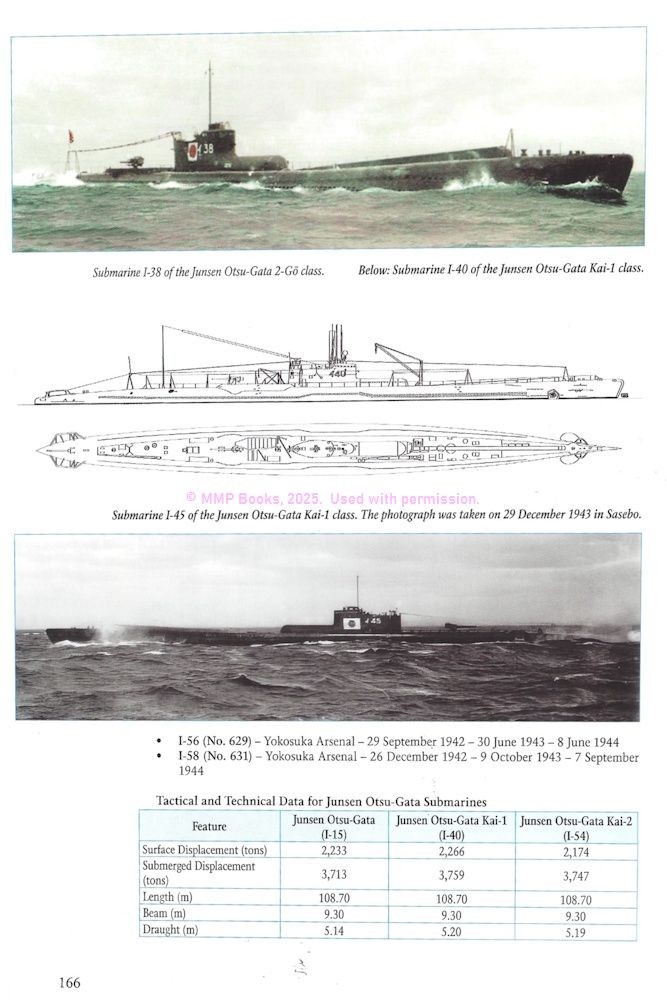
Photos of subs for the classes are accompanied by illustrations of representative boats. No scale is mentioned that I noticed although the drawings seem larger than 1/700.
Photographs, Artwork, and Graphics
This publication features a strong visual component. Modelers and researchers will greatly benefit from the photos and illustrations. Plenty of source material for detailing models or inspiration for dioramas is will be found on the pages. Naturally, the photos show submarines and aircraft although there are also portraits of pilots, sailors, and technical people. Specific components and equipment are included. Most of the photos are black-and-white although several color photos are included, some of which are film, some of which appear to be lithographs or colorized b/w photos. Image quality varies from poorly exposed or developed high contrast views, or fuzzily focused, through professional propaganda pictures, and technical photos, as mentioned above. Some notable photos include:
- Seiran pilot's and observer's seats
- Submarine I-54 in color
- I-6 underway alongside submarine tender Jingei
- USN personnel inspecting the open hanger of I-400
- Transport trolley of the I-400 catapult
- Watanabe E9W1 ashore on a trolley with personnel gathered around
- Kugisho E14Y1 seaplane approaching and awaiting to be lifted aboard I-37, as seen from the sub.
Illustrations and artwork, Black-and-white
Submarines: 18 line drawing profiles.
Aircraft: 61 line drawings, including:
German Heinkel-Caspar U2
Yokosho 1-Go prototype.
Yokosho 2-Go and Yokosho 2-Go kai: profiles; top and bottom planforms; head-on; fuselage cross sections x 3.
Yokosho E6Y1: profiles; top and bottom planforms; head-on; fuselage cross sections x 3.
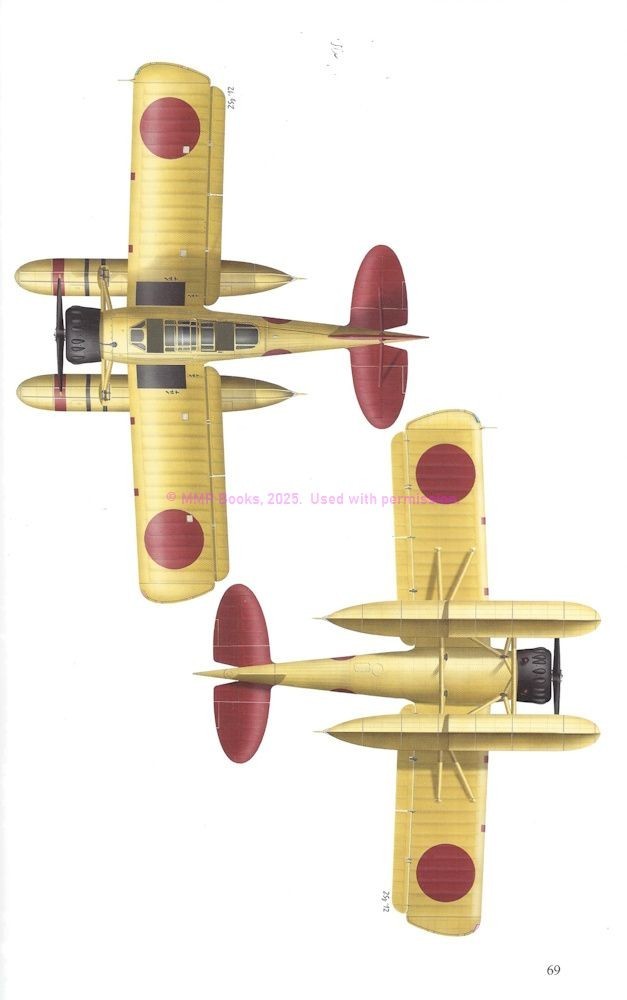
Watanabe E9W1 (9-Shi) prototype: profiles top and bottom planforms; head-on; fuselage cross sections x 3.
Watanabe E9W1 Model 1: profiles top and bottom planforms; head-on; fuselage cross sections x 3.
Kugisho E14Y1: top and bottom planforms; three profiles; head-on.
E14Y2 Model 12 in planform, profile, and from the front.
Watanabe E14W1: profiles top and bottom planforms; head-on; fuselage cross sections x 3.
Aichi M6A1-K Seiran/Nanzan: 14 views in profile; planform; front; in flight or on the surface; wings folded.
Kugisho Ohka 43 Ko-Gata in profile, planform, and nose-on.
Kawanishi Baika 2 in top and bottom planforms, profile, and nose aspect.
Kawanishi Baika 3 in top and bottom planforms, profile, and nose aspect.
Illustrations and artwork, Color
Yokoshō 1-Gō: in planform and profile.
Yokosho 2-Go and Yokosho 2-Go Kai: two profiles and planform.
Watanabe E9W1 Model 1: planform and profile.
Kugisho E14Y1 prototype in profile.
Kugisho E14Y1 wearing yellow-orange test aircraft finish of ou-shoku, close to Kariki 117 C4: three profile with one on a trolley; top and bottom planforms.
Kugisho E14Y1: 14 Glens in several profiles and planforms depicting seven aircraft.
E14Y2 Model 12 in profile.
Japanese fire bomb.
Aichi M6A1-K Seiran/Nanzan: seven profiles of test and operational M6As in several paint schemes; one planform; close-up of Ensign Takahashi's spinner with his protest painting.
Kugisho Ohka 43 Ko-Gata in profile.
Kawanishi Baika 2 in profile, and the Ka-10 engine without its cowling.
Maps
Firebombing sites in Oregon - two maps showing the September 9, 1942 attack as remembered, and actual ground tracks; the Sept. 29 attack.
Three planned attacks on continental United States, and the Panama Canal.
Panama Canal attack keyed to five event.
Ulithi Atoll attack keyed to three events.
Ulithi Atoll attack close-up.
Certainly a lot to feast our eyes upon for research, source material, and pure enjoyment.
Conclusion
Japanese Submarine Aircraft from MMPBooks is thorough and exceptionally researched and presented. The authors have presented us with a book that covers many aspects of the subjects, in satisfying detail. The color and black-and-white illustrations are equally detailed. While some photographs are fuzzy, the photos enhance the narratives and descriptions.
I think that if you are a modeler, historian, or enthusiast of Japanese submarine aircraft carriers or regular subs, sub-launched aircraft, and special missions by the Japanese, that you will find this book indispensable. Recommended.
Thanks to Casemate for providing this sample for review. Please remember to mention to Casemate, MMPBooks, Stratus, and retailers that you saw this product here - on Aeroscale.