












Introduction
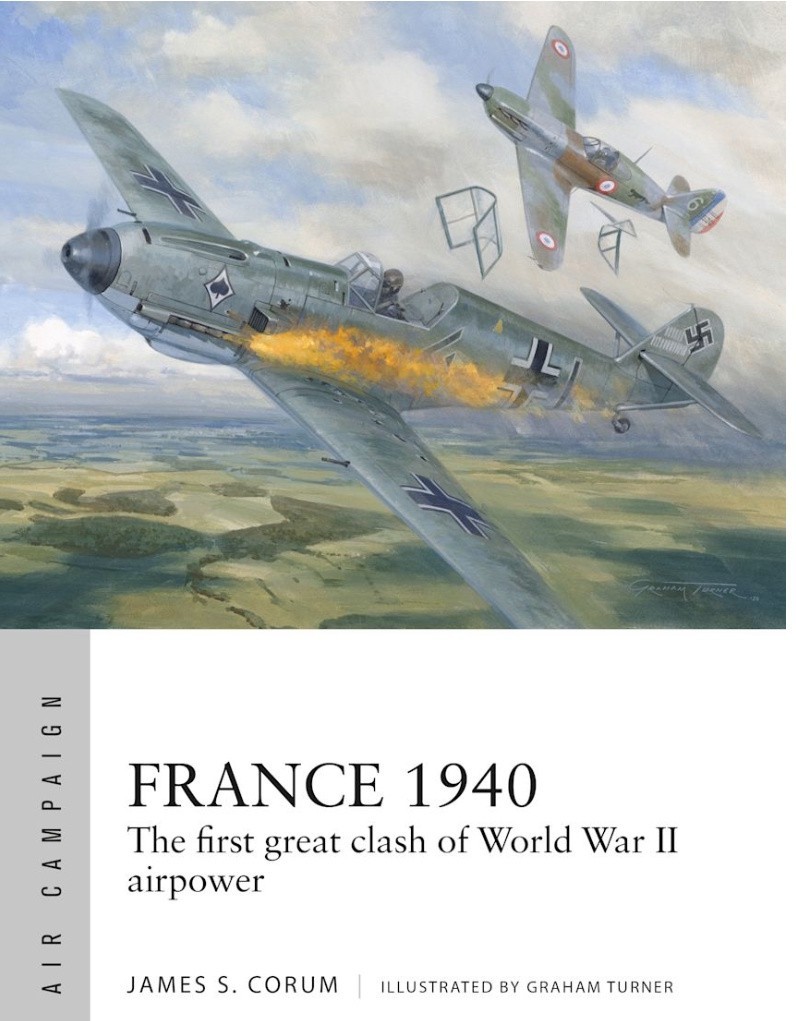
France 1940 The first great clash of World War II airpower is a recent release from Osprey Publishing is the 53rd title in their series Air Campaign. Authored by James S. Corum and illustrated by Graham Turner, this 96-page paperback features 60 photos and 14 pages of colour illustrations, and is catalogued with ISBN 9781472864833. It is also available in PDF, ePUB and Mobi.
We build models of what interests us and things interest us by learning about them. Thus, this exploration of the air war over France presents modelers and historians is a source for learning and inspiration. This book presents plenty of photos suitable for detailing models and cultivating ideas for dioramas.
The battles for France and the Low Countries was a clash of vision, doctrine, and developments cultivated after the Great War of 1914-18. The three great powers, Britain, France and Germany, took different courses between the wars. This publication demonstrates which path was successful.
Contents
France 1940 follows the Air Campaign format of 11 chapters, subsections, and front and back matter divided amongst its 96 pages:
Table of Contents
Introduction
Chronology
Attacker's Capabilities
Defender's Capabilities
Campaign Objectives
The Campaign
Aftermath and Analysis
Conclusion
Bibliography
Index
Through this book we examine the senior military and air force leadership, policies, doctrine, composition, functions and abilities of the air forces and their equipment.
Introduction is a few pages reacquainting us with RAF uninspired doctrine, the French High Command's neglect and ineptitude before the first shots were fired, and Frances's hundreds of American warplanes that were too little or too late.
Attacker's Capabilities, and Defender's Capabilities, are two interesting overviews of the forthcoming campaign. It discusses equipment performance and overall strengths and weaknesses. This includes forces beyond airplanes such as anti-aircraft capability, communications, etc. We are reminded of Germany's World War I Luftstreitkräfte and the Versailles Treaty, Germany's foil of the treaty, and development leading to war. It recounts the organization of aircraft units and the new idea of the Fliegerkorps (Air Corps), and execution of air-ground coordination. Subsections acquaint us with German doctrine, Luftkriegsführung (Luftwaffe Regulation 16, or Conduct of the Aerial War), German commanders, and present callouts with detailed Orders of Battle. Combat experience and how it modified existing doctrine is reviewed.
Anglo-French airpower begins with the l'Armée de l’Air (French Air Force) and its forging by the Superior War Council (Conseil Supérieur de la Guerre (CSG), theorist General Giulio Douhet's influence, their concept of the Bomber-Combat-Reconnaissance (BCR) aircraft, and dysfunction of French logistics and organization.
Next we learn about the British Air Forces in France (BAFF). In contrast to France, Air Chief Marshal Hugh Trenchard guided the Royal Air Force (RAF) for many years and prepared it for expansion. Yet, consequences of RAF priorities and the effect in France are discussed.
There is some interesting trivia and revelations (for me at least) such as the impact of Generalmajor Wolfram von Richthofen's PhD thesis on the Luftwaffe, and the impact of French politics on their NCOs
Campaign Objectives are discussed for the Allies and the Germans. If you are familiar with Germany's World War I Schlieffen Plan and the 1939 Fall Gelb (Case Yellow) plan, then this chapter is a review, except with the addition of maturing airpower.
The war starts with The Campaign. Forty-five pages, including charts, maps, and artwork, lead us from the opening rounds through Fall Rot and the Allied evacuation at Dunkirk.
Overall the book is well written and flows easily. There are a few typos, mostly de minimis, although a grammatical inconsistency of mixing spelled numbers vs. using numerals shows the the Dewoitine D.520 fighter as armed with a "120mm" cannon.
Analysis and Conclusion wraps up why the Germans defeated the British and French over France.
Photographs, Artwork, Graphics
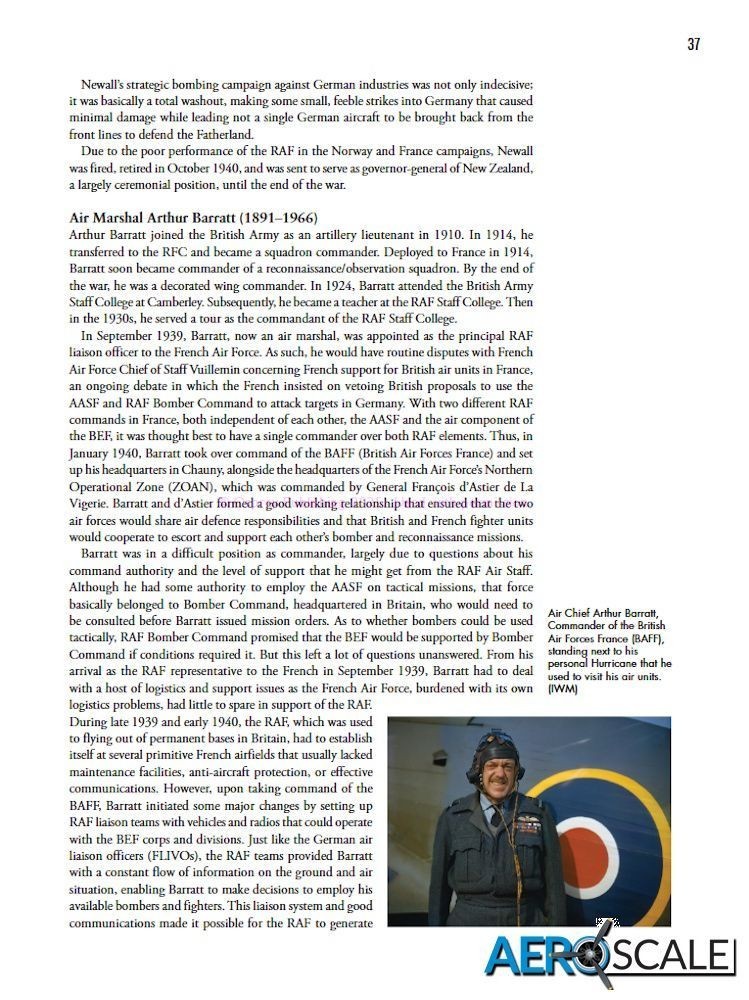
Most of the photos are black-and-white but there are two in color. One of them being a high-quality shot of a British officer next to his aircraft, which gives a good look at the colors and markings of the man and machine. Some photos I find particularly interesting are:
- Zero-altitude view of an attacked German column from the back of a RAF Fairey Battle.
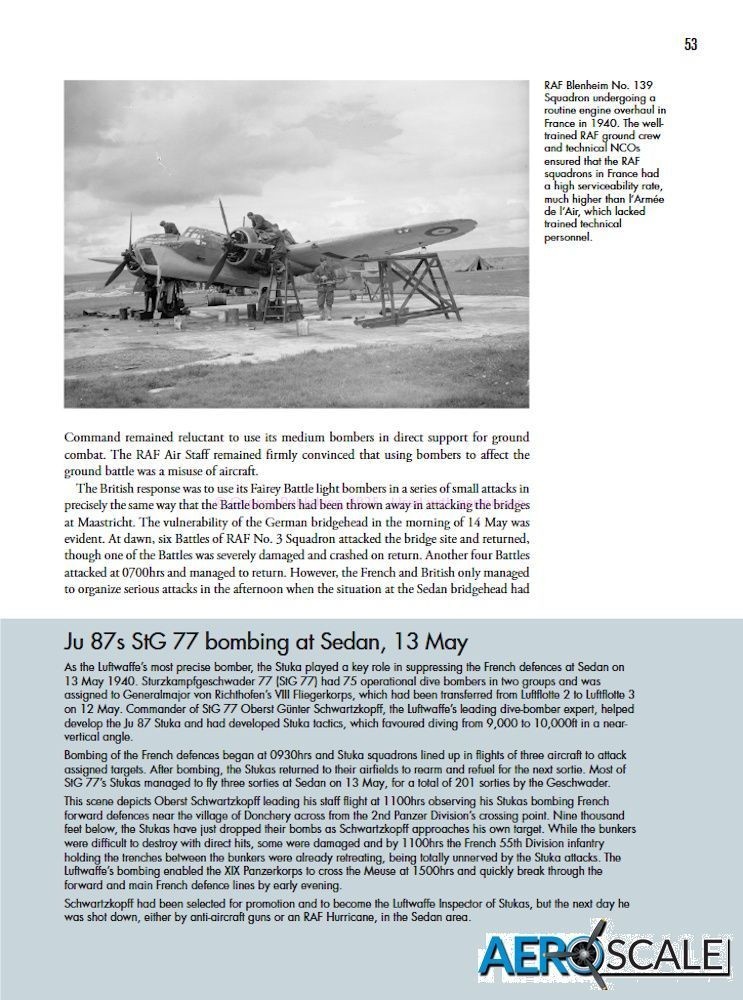
- Blenheim field maintenance.
- French ordnance.
- Several scenes of German Command, Control, and Communications.
All have useful captions of varying lengths.
My one critique is the size of the photos. They are small. That said, most were professionally shot during the war and reproduced for this book.
Artwork & Graphics
Ju 87s StG 77 bombing at Sedan, 13 May: two-page aerial view of the StuKa attack.
3D bird's-eye view Sedan: 12-13 May, keyed with nine ground attacks and four air actions.
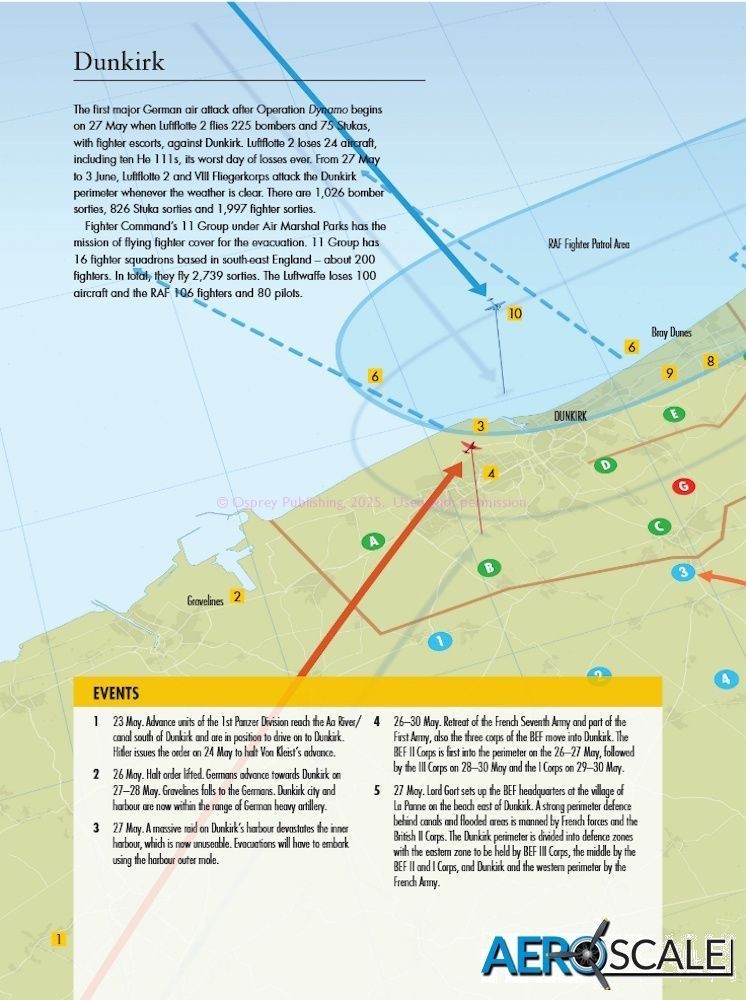
3D bird's-eye view Dunkirk: keyed to 10 actions.
French naval dive bombers attack the Panzer advance at Berlaimont, France, 18 May: two-page aerial view of the Loire-Nieuport LN.401/411 dive bombers flying into the teeth of 2cm and 3.7cm flak.
Luftwaffe’s top fighter pilot shot down by French D.520: Hauptmann Werner Mölders tasting the consequences of misjudging a French fighter pilot.
Tables
Orders of Battle - Germany
Orders of Battle - Allied Forces
Maps
French Air Bases 1940.
French Zone Nord including RAF bases.
Opening moves, 10-14 May: keyed to 12 events and six Allied armies.
Final phase of the campaign: Fall Rot: keyed to five events.
Bomber Command Bases
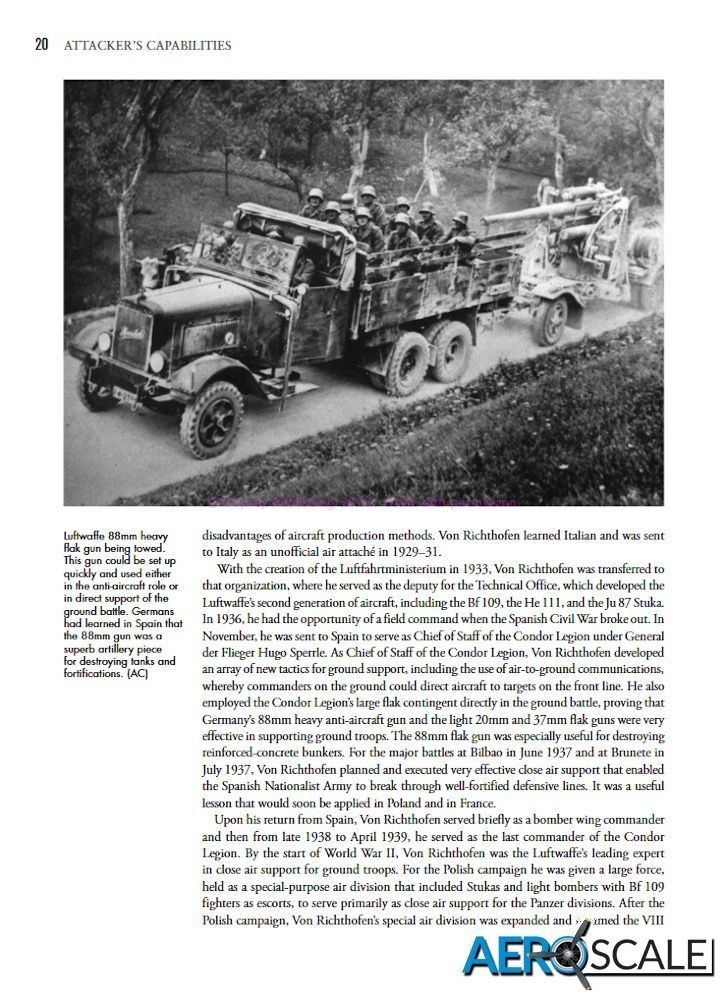
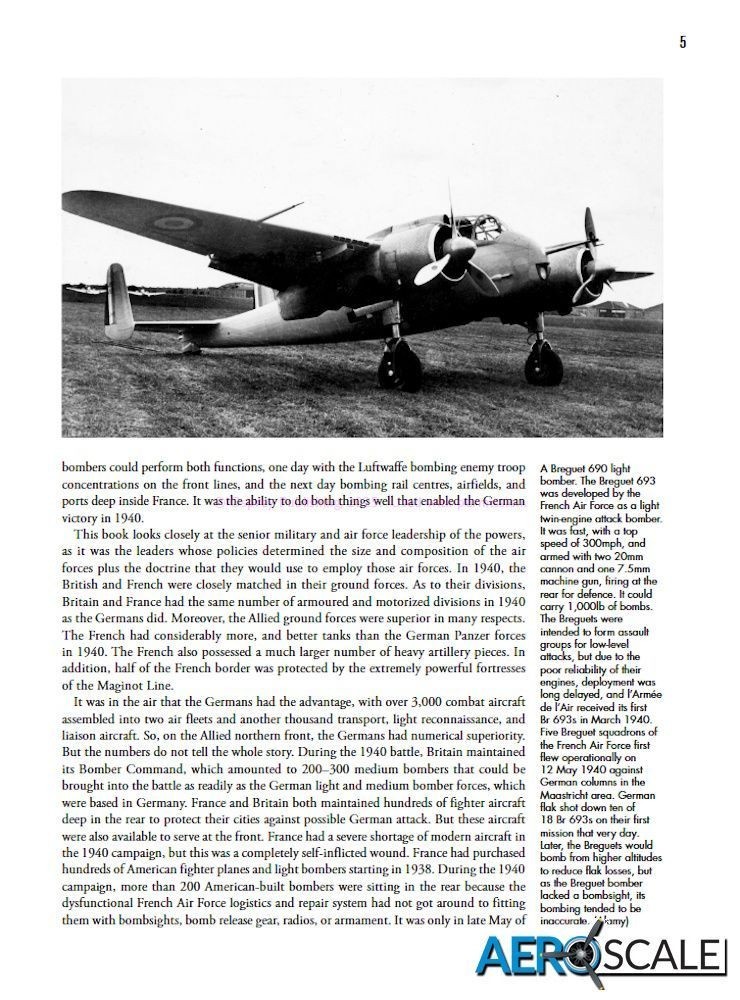
Below are examples showing the pages, sizes, 3D-views, aircraft and other aspects of the visual component.
Conclusion
Reader familiar with the campaign will understand most of it although there are some concepts that are surprising. The visual support of the text is good aside from the aforementioned critiques.
More so than other 1940s campaigns - even the Battle of Britain - France captures the imagination of many modelers and historians due to the ground and air components, and its scope. Personally, I believe this book is essential to understand the role and effect of airpower in 1940. Recommended.
Please remember to mention to Osprey and retailers that you say this product here - on Aeroscale.