












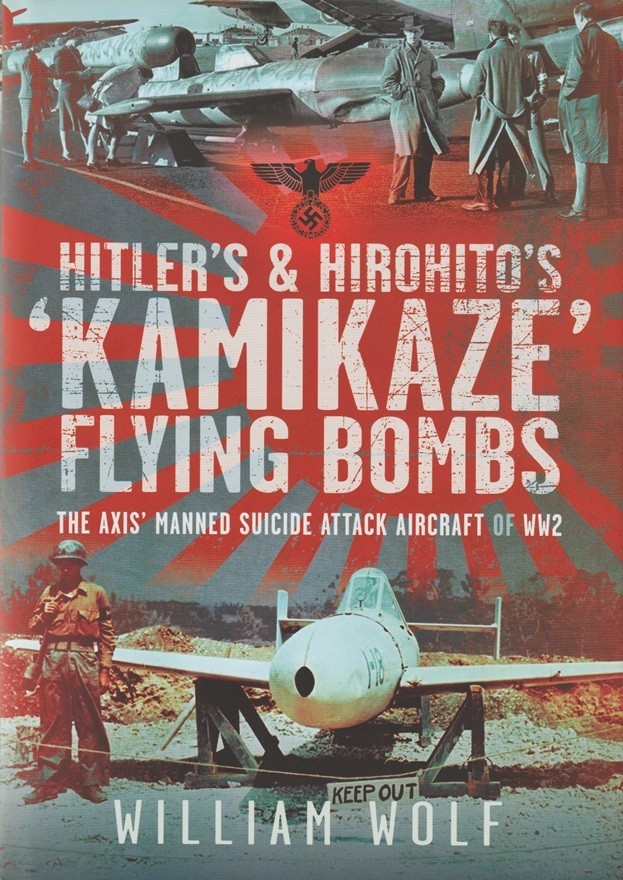
HISTORY:
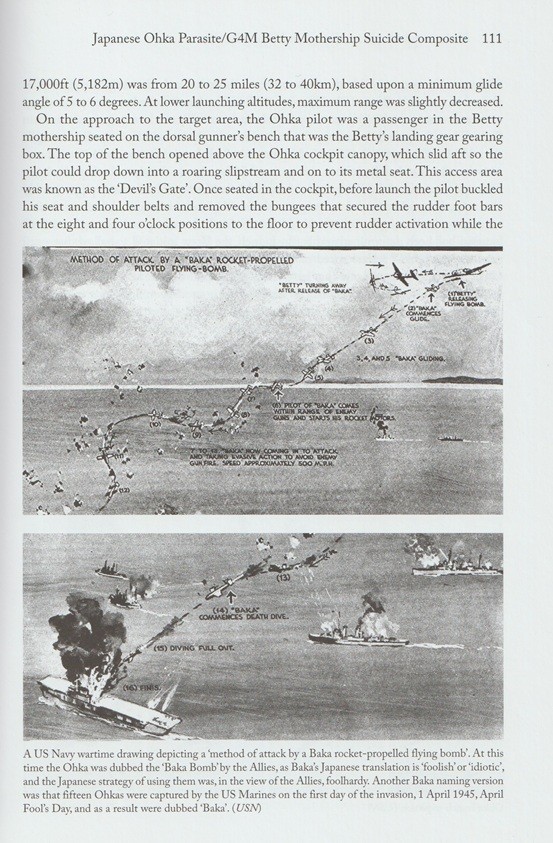
** On 1 April 1945, US troops launched the largest amphibious assault of the Pacific War on the heavily-defended island of Okinawa. Supporting the invasion, the USS West Virginia participated in the bombardment of entrenched Japanese defenders. That evening, a Japanese aircraft launched a Yokosuka MXY-7 Ohka, a rocket-powered kamikaze plane. West Virginia was hit by an Ohka, becoming the first ship damaged by such a weapon. Twelve days later, the USS Mannert L. Able became the first ship sunk by an Ohka.
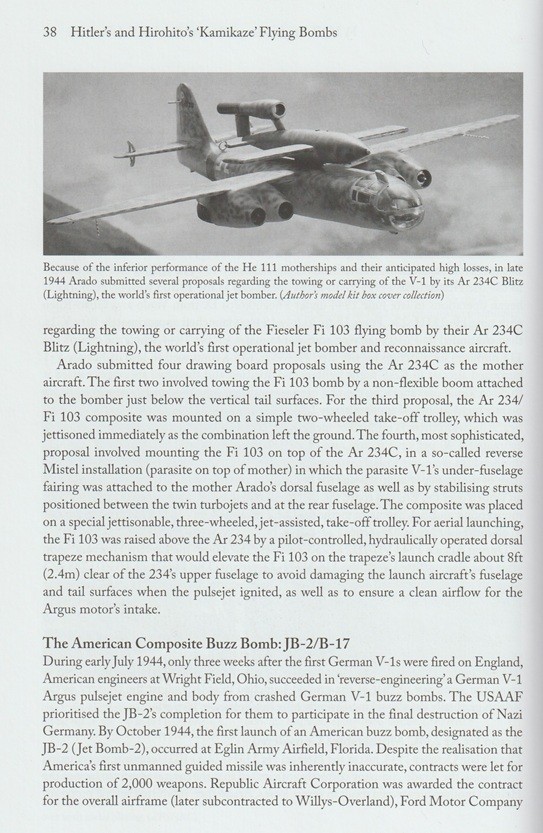
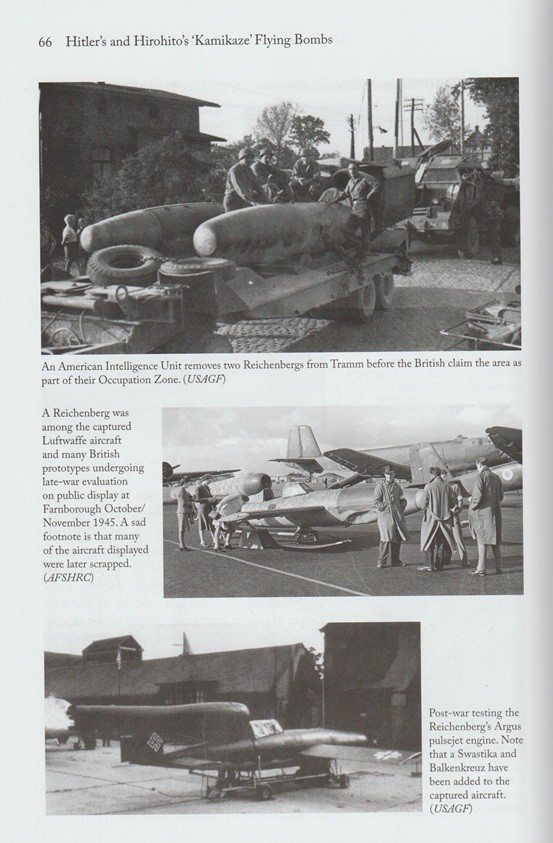
The deployment of the Ohka was a desperate measure by Japan as the war turned against them. This manned flying bomb evolved from earlier kamikaze tactics. However, the Germans had also considered similar weapons. As early as 1944, figures close to Hitler, such as Otto Skorzeny and Hanna Reitsch, advocated for kamikaze missions. Hitler authorized the creation of the Leonidas Staffel to prepare for these attacks, leading to the development of the Messerschmitt Me 328 and Fieseler Fi 103R, also known as the Reichenberg.
Though the Fi 103R began production in October 1944, the changing dynamics of the war rendered it obsolete by the time it was ready for use. The project was formally abandoned in March 1945. This book details the development of both the Ohka and Reichenberg.**
** Quoted from the Casemate Publishers’ website.
THE BOOK:
Air World has released Hitler's and Hirohito's 'Kamikaze' Flying Bombs, The Axis’ Manned Suicide Attack Aircraft of WW2 as a 231-page hardcover book, 6.75 x 9.75 inches in size. Included with the text are black and white photographs as well as black and white scale line-drawings. The book has a 2025 copyright, a publication date of November 30, 2025, and the ISBN is 978-1-0361-1927-0.
CONTENTS:
Preface
Acknowledgements
Introduction
Part 1: German Manned Parasite Suicide Aircraft
Chapter 1 Me 328 Manned Parasite Suicide Aircraft, Reichenberg Precursor
Chapter 2 Fi 103R Reichenberg Manned Suicide V-1 Parasite
Chapter 3 Nazi Drawing Board Suicide Parasite Proposal
Part II: Japanese Manned Suicide Composites
Chapter 1 Japanese Okha Parasite/G4M2e Berry Mothership Suicide Composite
Chapter 2 USN Kamikaze Detection and Defences: Picker Ships, CAP, and AA Defences
Chapter 3 Conventional Kamikaze Attacks: A Synopsis
Chapter 4 Ohka Combat Operations
Chapter 5 Ohka Further Design and Development
Chapter 6 Kawanishi Baika (Plum Design)
Chapter 7 Mizuno Shinryu II (Design Dragon)
Bibliography
Index
THE TEXT:
Author William Wolf provides a well written and informative text detailing suicide aircraft used by both Japan and Germany during World War II. The text goes into very specific detail in all areas of the book as outlined on the contents page, please refer to the contents listing that I have provided for the areas that are covered through the book. As shown in the contents listing, the text is separated into two sections for the German and Japanese subjects. The German portion of the book is covered from page 3 to page 77, and the Japanese portion of the book is covered from page 81 to page 215. The author discusses the various aircraft to include those that were built and used, those that were built and not used, to those that never went farther than the planning and design stage. The development and testing stages are discussed in great detail as well as the camouflage and type of warhead installed if one was used. Key individuals involved with the various aircraft programs are profiled and information is provided on their contributions to the various projects. Information on the various aircraft is provided such as the length, wingspan, fuselage diameter, empty and loaded weight, speed and range of the specific aircraft. When discussing the engines used, specifics are included such as the engine length, diameter, weight, and other technical specifics. The internal and external materials used in construction of the aircraft such as steel pipe, plywood, wood veneer, armored glass, and the thickness of them, pyrobolts (also called explosive bolts), asbestos insulation is also discussed in detail. The various types of engines used, their manufacturers and their specific operation and capabilities are detailed as well as the type of fuel they used, and the capacity of the fuel tank(s) installed. Information provided from the early testing phases details what worked well as well as flaws and malfunctions that were discovered. In addition to his own words, William Wolf has also provided quotes from German aviator and test pilot Hanna Reitsch, US Navy Vice Admiral Lloyd Mustin, Japanese Rear Admiral Toshiyuki Yokoi and several others. I feel that William Wolf has covered the Axis’ manned suicide aircraft well and has provided the information in an easy-to-read format which the detailed oriented reader will benefit from. William Wolf doesn’t use what I refer to as fluff writing where a large amount of non-essential extra text is provided just to help fill the pages. It is obvious that the author has gone to great lengths to research the various aircraft discussed. As I read through the text, I didn’t notice any spelling or grammatical errors. Grammar and spelling might not be an important factor to everyone however it is something that I take notice of and pass on my findings. As a reader that had some knowledge regarding some of the German and Japanese suicide aircraft, but not all of them, I found myself to be well informed on the subject upon finishing the book.
THE PHOTOGRAPHS:
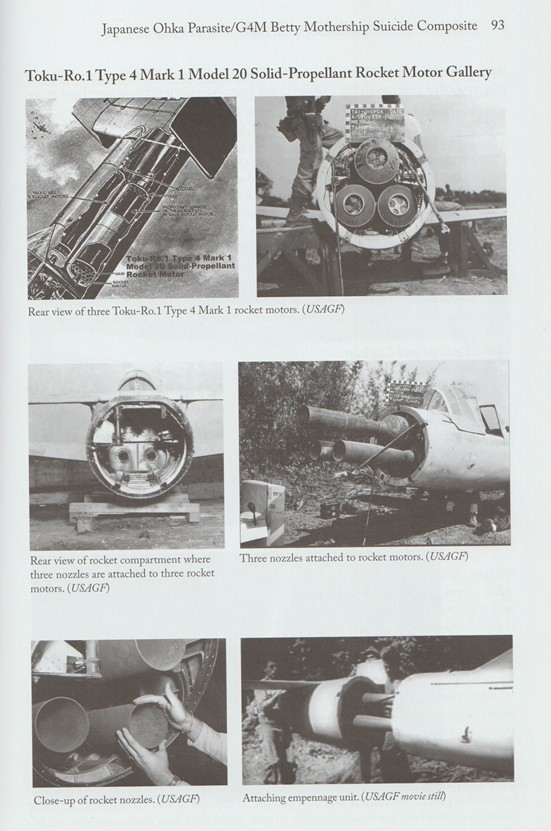
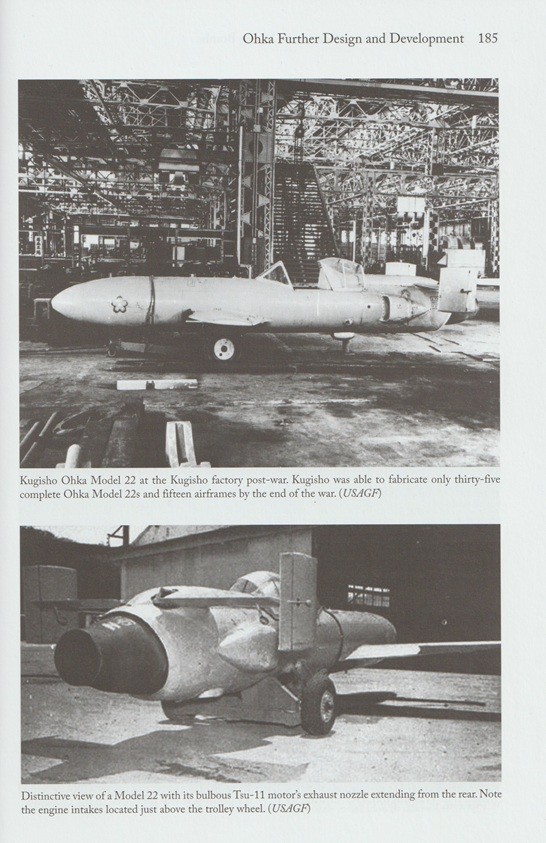
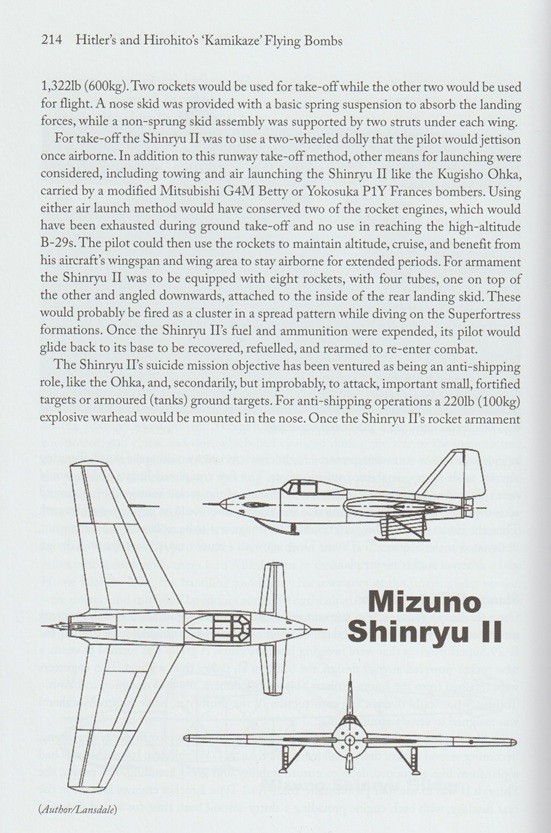
There is a total of 241 black and white photographs included in this volume. No color photographs are featured. Author William Wolf chose subject specific photographs and did not include photographs that strayed from the main subject of the book. The photographs range from wide angle photographs to close-up detailed photographs. They are a combination of in-action photographs, photographs removed from motion pictures to photographs that have been staged for the photographer Most of the photographs are well done, however there are some that have an out-of-focus look to them, and some appear to be too dark and others too light. This is typical for the period of history being discussed and the quality of the photographs is no fault of the author and does not take anything away from the book. One thing that I was appreciative of with the photographs is that a good majority of them are not overused photographs that tend to turn up in other publications dealing with the same subject. The photographs cover a variety of subjects to include the various suicide aircraft, various aircraft that were used to transport the suicide aircraft to their operation areas and other aircraft of the period, weapon launch sites, manufacturing and assembly areas, transportation vehicles, naval vessels, anti-aircraft weapons and others. I appreciated the fact that there are several close-up photographs of the various aircraft as a whole as well as photographs of key components such as the engines that were designed and used. There are also photographs that show great details of the various cockpits and the controls and gauges that were utilized. As well as the photographs of the suicide aircraft, there are several pictures of key individuals, German and Japanese, involved with the various projects as well as German and Japanese pilots and other military members. Other images included that I think the reader will appreciate are the drawings and line drawings of the actual and conceptual suicide aircraft. The majority, if not all, of the photographs will prove to be of great interest to anyone interested in the manned suicide aircraft used by Germany and Japan during World War II due to the details they contain.
THE CAPTIONS:
The captions are well written and explain the accompanying photographs nicely. The captions go into very specific detail as to type of aircraft shown, specific type of suicide aircraft, what the items that are shown in the cockpits, describes specific components of the various suicide aircraft shown, details of various aircraft markings, the names and types of naval vessels shown, types of weapons shown, the actions taking place, dates and locations, individual’s names and military rank or civilian title, military units, personal quotes, and other such information. As I read through the captions, I didn’t notice any spelling or grammatical errors. I was impressed by William Wolf’s captions as they are very helpful to the reader due to the detailed content that they contain.
CONCLUSION:
This is the first Air World title that I have reviewed, and I was impressed with the book. This is a very nice reference book that contains a well written informative text, many subject specific photographs, well detailed captions and more, all detailing the German and Japanese suicide attack aircraft designed, planned and used during World War II. I would have no hesitation in recommending this book to others as it will be a welcome addition to one’s personal military reference library.
Air World's, Hitler's and Hirohito's 'Kamikaze' Flying Bombs, The Axis’ Manned Suicide Attack Aircraft of WW2, is also available digitally from:
Barnes & Noble
Kobo
PRICE
UK £14.99 / US $26.95
https://www.pen-and-sword.co.uk/Air-World/i/40
https://www.casematepublishers.com/
This book, from Air World, an imprint of Pen & Word Books, was provided to me by Casemate Publishers. Please mention that you saw the book reviewed here on the KitMaker Network when making your purchase. Thank you.